This essay first appeared on my Substack, Agape Sophia.
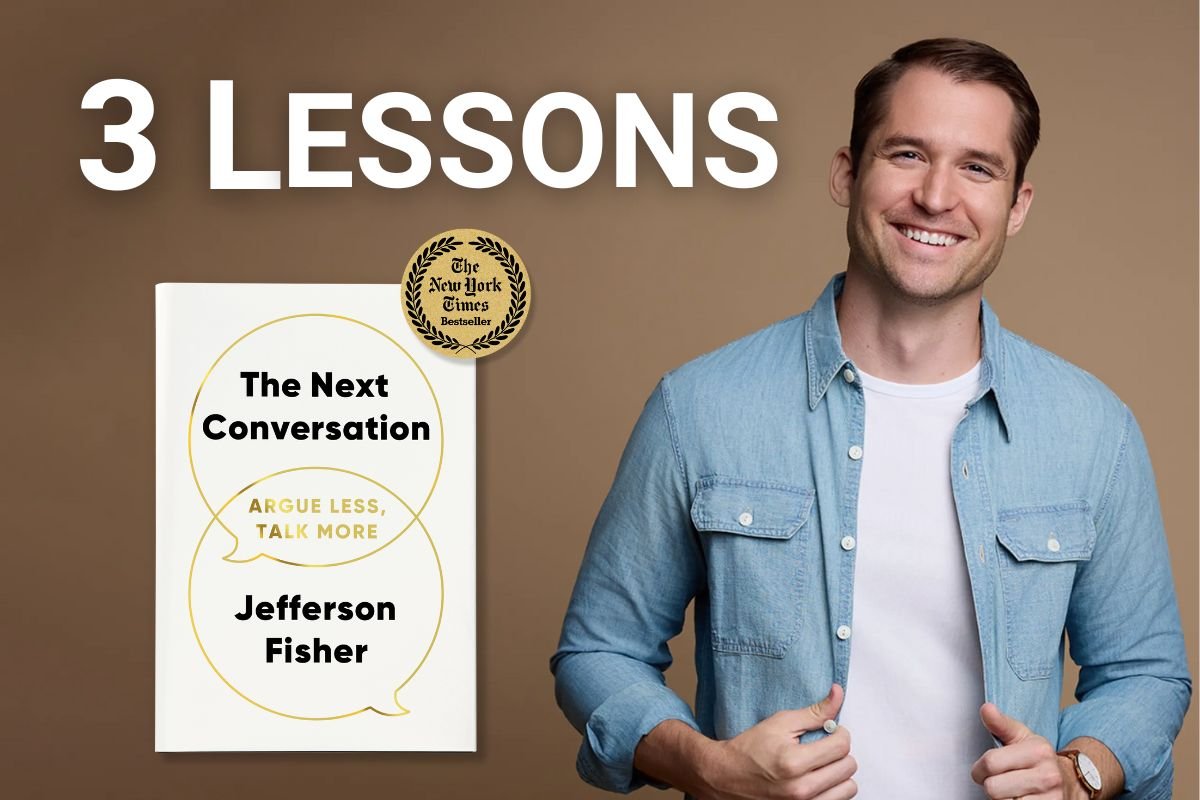
Jefferson Fisher and The Next Conversation
Jefferson Fisher teaches his followers how to communicate confidently without sacrificing kindness. His new book, The Next Conversation: Argue Less, Talk More, became an instant bestseller—and for good reason.
The small-town Texas trial lawyer gives powerful advice in short, casual videos. Through his approachable style and impactful message, he's amassed over 10 million social media followers.
Here are three lessons I learned from him.
I Was a Researcher for The Next Conversation
I had the pleasure of researching for The Next Conversation, which rocketed into the New York Times bestseller list within a week. Jefferson's book coach and my former boss, Blake Atwood, connected us.
I enjoyed working in the manuscript phase, filling in gaps with scientific studies, occasionally pushing back on certain claims, and citing research validating his strategies. The Next Conversation is straightforward in the best way. Instead of cluttering the work with redundant scientific studies, he stuck to the point. Looking back, and reading it now, I'm glad he stuck to his guns, maintaining his signature approachability.
Because, as the saying goes, keep it simple, stupid.
I'm a philosopher. My head is often in the clouds, and it can get severe up there. Keeping things simple and clear is unsurprisingly difficult for me.
I have three takeaways from Jefferson that weren't explicitly given in the book, but which help me regulate my overthinking.
Lesson 1: Keep It Authentic
I appreciate the way Jefferson stuck to his personal, plain, and straight shootin' style of writing. Truth and value can be complicated, paradoxical, or knotty, but that's not always the case.
In The Next Conversation, Jefferson primarily draws from his experience as an attorney and his God-given, humble, Texas-twanged, family-instilled charisma. His roots led to his social media success, so why change it for the book? It's not that he couldn't make it dense or high-minded—he's an attorney of law! He deliberately chose to value his broad audience and keep his written work accessible.
In my review for The Denison Forum, I say it this way:
"Jefferson Fisher won an audience of 10 million followers on social media by giving communication tips in a winsome, casual, and authentic manner—and his book is no different."
The Next Conversation is no Paradise Lost, but literary sophistication is not Jefferson's goal. It's also not him—such flowery styles, although poetic, are inaccessible. Developing and sticking to your voice is exceptionally difficult.
Jefferson does so brilliantly.
Lesson 2: Effective Simplicity
The Next Conversation exemplifies what I call effective simplicity. The generality of its content makes it approachable. Such straightforwardness clearly draws a diverse audience, so why do quality editors, career writers, and academics so frequently push back against generality?
To make simplicity effective, make sure it passes three tests: usefulness, correctness, and productivity. Let me explain.
1. Usefulness
Generalities (usually) aren't useful, because when I ought to use the principle is underdetermined. It's useless to say, "Sometimes, you should carry cash on you." Okay. When?
Vagueness is the enemy of effectiveness.
Internet natives will know the reference, "instructions unclear…"
2. Correctness
Alternatively, universals are seldom true. Instead of "sometimes," let's insert "always" in the cash example. "You should always carry cash on you." In many cities, however, there doesn't seem to be a single thing you'd need to buy with cash.
For another example, take the trope "Americans are obnoxious." (Okay, well, that one might be true.) It's funny to kid about, but genuinely, that statement is only partially true from another point of view, namely, from the perspective of more subdued and reserved cultures or personalities. Generalities (usually) lack the necessary context for truth.
3. Productivity
Due to (1) and (2), generalities don't add value because they are neither correct nor effective, so I can't learn anything or do anything better. Of course, (1–3) are themselves generalities, showing by paradox the way simplicity can be useful, true, and productive.
Broad statements need to be specific enough to be useful and true. Instead of "Always carry cash on you," for example, try "Carry cash on you in Mexico City." Even more specificity might help. "Carry pesos on you in Mexico City." Pesos is implied in the first sentence, but it's still a good reminder.
However, "Carry 2,000 pesos on you in Mexico City" is too specific. If you're staying for a month with a large family, that's not enough. If you're stopping by for one day by yourself, it's too much. Valuable advice is created by being specific enough.
The upshot of Jefferson's work is that his communication strategies work in any conflict or difficult conversation. But there are limits.
His advice doesn't work in small talk (although it would be funny to say, "I need to set parameters around this discussion. We will talk about the weather.") But challenging discussions of all kinds frequently happen, and his strategies work for all of them.
Writers and academics, especially philosophers, learn to make their claims as specific as possible, but sometimes, generalities generate value. The Next Conversation works well because Jefferson's general advice is useful, true, and, therefore, productive.
Lesson 3: Limit Overthinking
Finally, I applied his advice from chapter seven to create simple reminders to increase my assertiveness. Instead of increasing my assertiveness for my social life, I did it to increase my assertiveness in my own headspace. Limiting overthinking will, I hope, increase my confidence and outward-facing assertiveness.
My thoughts are often too jumbled. As a philosophically minded person, whose job is peddling ideas, I have too many, too often. Problem: How do you clock out of having ideas?
I've decided to do a few things, in the style of simple, general, Jeffersonian advice.