It's a monumental task to write a book—but publishing the thing yourself? It can be overwhelming, especially when it comes to finding the best editors. Marketplaces like Reedsy and the Editorial Freelancers Association make it easier to find the right fit, but you're still left to wonder: Which editors do I truly need? Ideally, you'd hire every kind, but you're on a budget, so you need to prioritize.
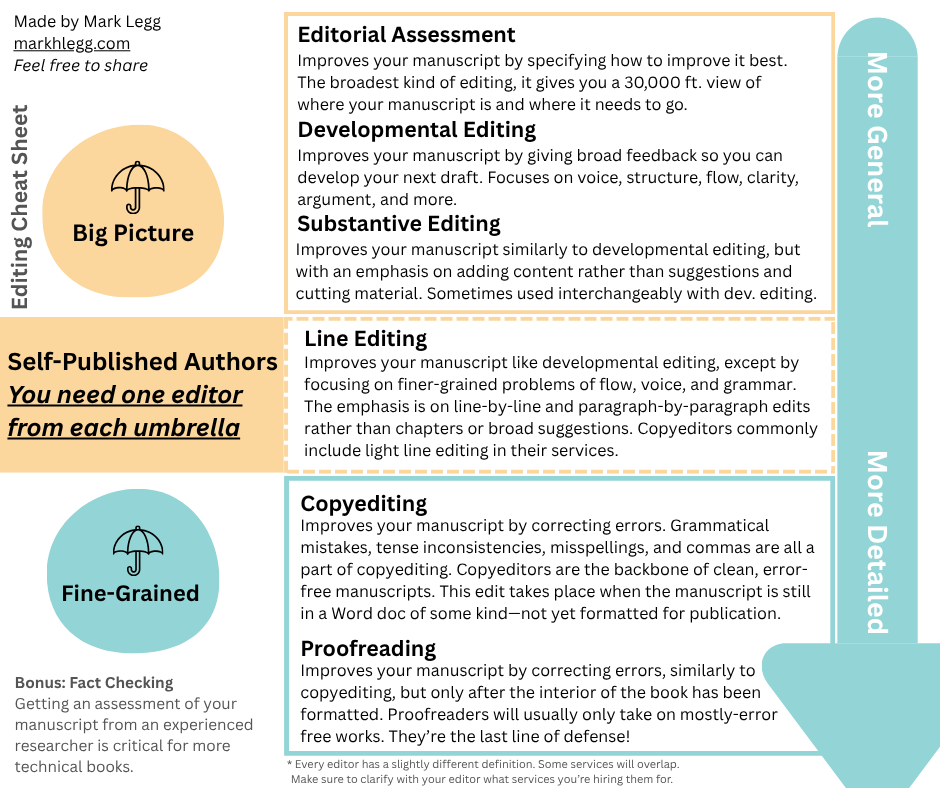
I talk about two umbrellas of editing with my clients: big picture and detailed editing. My advice: You should hire at least one from each umbrella.
The Two Umbrellas
Most people imagine copyediting or proofreading when they think of editing. It's remembering all those pesky rules about hyphens, capitalization, and spacing. That's detailed editing. But there's also big picture editing. That's getting feedback on ideas, argumentation, flow, consistency, voice, readability, and fact-checking.
I've created a graphic below. You're welcome to share and repost it. Under each umbrella, there are several kinds of editing, each with a simple explanation.
How Many Kinds of Editing Are There?
If you do a quick Google search, you'll find countless results with different answers to "how many kinds of editing are there, and what are they?" You'd think it's simple, right? In the same way that you'd think hyphen rules are settled (they're not), you expect the editing community to have solved this question. Well, no. Usually, folks cite four or five main editing branches.
- Reedsy, a premium freelancer marketplace, says four
- Jericho Writers outlines five
- The Editorial Freelancers Association gives five plus two kinds of reading
For example, some people say developmental editing and substantive editing are the same. Others say substantive editing is more involved, with the editor changing more, rather than just giving general advice.
It's easy to get confused. I've made my own list with descriptions of each, but it's relatively subjective, and it's worth noting: Make sure you're clear with editors about what services you're hiring them for. For example, editors I spoke to said they often include light line editing in copyediting—these categories often overlap. It straddles the big picture/detailed picture line.
Regardless, I recommend the two-umbrellas method.
Self-Published Authors: Get One Big Picture and One Detailed Editor (at Least)
You need at least one big picture editor and one detailed editor. The choice between detailed editing is pretty easy: Get a copyeditor, almost 100 percent of the time. If you already have extensive experience in editing, you can skip this and hire a proofreader instead. But nine times out of ten: Go for a copyeditor—they're the backbone of good, error-free books, God bless them. Several copyeditors I talked to said they usually include some line editing.
What kind of big picture editor you choose depends on where you are in the writing process. I'll offer my opinion on when you should hire certain editors.
- If you feel stuck with your draft, and aren't sure if it's ready to publish, get an editorial assessment.
- If you're in a rough or second draft, and feel like something's off, or if you need help organizing or structuring your work, hire a developmental editor.
- If you need extra help hitting a word count, and want the benefits of the developmental edit too, secure a substantive editor.
- If you're mostly done, but want to tighten up the manuscript, get a line edit.
If you can hire a third editor, congratulations! You're ahead of the game. Which umbrella you hire from next depends on you and your manuscript's strengths and weaknesses. If you received a recommendation for lots of big-picture changes, with the need for substantial rewrites, then I'd recommend following all that the big-picture editor recommends, then hiring another big-picture editor to follow up (or the same one again).
If you only hire one detailed editor, you need a copyeditor, as I mentioned. Next, you'll want a proofreader. If you have the time, patience, and skills to catch all the final, last-minute errors in your ready-to-print PDF, you can skip a proofreader—but I wouldn't. It's tedious work to use even the easiest book design software (like Scrivener, Reedsy, or Atticus). Proofreaders help you catch the tiniest flaws.
How Much Will Editing Cost You?
Great question—you knew the answer, didn't you? It depends!
A good baseline (and I emphasize baseline, here) is given by the Editorial Freelancers Association, where I'm a member. This sheet offers a range of what their editors typically charge—but these numbers should be considered a starting point.
Experienced editors, especially with niche insight, will charge more. For this reason, I recommend avoiding Fiverr and Upwork. They tend to be races to the bottom—freelancers charging insanely low, unlivable rates, sacrificing quality for quantity. Some great freelancers use these sites, but at least make sure to not sort "low" to high price.
As a self-published author, you can expect to spend $4,000–10,000 to follow the two umbrellas approach.
Finding the Right Editor
If you're looking for a big picture editor of any kind, especially in the realm of Christian non-fiction, I'd love to help. Take a perusal around my website and reach out for a free consultation.
If you have a larger budget and time to wait, I recommend my friend and mentor, Blake Atwood. He specializes in book coaching, ghostwriting, and big-picture editing. He's worked on a few NYT bestsellers. Needless to say, he's in high demand.
If you're looking for a copyeditor or proofreader, I enjoyed working with Christi Marti. She does excellent, rapid work for great prices as well.
I recommend finding editors and reaching out to them directly. Marketplaces charge them, or you, or both, a finder's fee. Do a little research to find them yourself. You can always look them up in marketplaces to see if they have good reviews. Ask for writing samples and take them up on the offer to meet—I love to establish that personal connection.
Feel free to share the two umbrellas cheat sheet on socials if you're a writer, and with your clients, if you're an editor. Reach out if you're interested in ghostwriting or big-picture editing (marklegg.writing@gmail.com).
Happy writing,
Mark